
Streamline Process Management
When the Process Looks Fine but the Equipment Isn’t
What changes in control behaviour can reveal about developing equipment problems
The process is holding setpoint. Production is running. No critical alarm has fired.
On the screen, everything looks fine.
But the controller may be working harder than it did yesterday to keep it that way.
Normal process output does not always mean the equipment producing it is still behaving normally.
Industrial control systems are designed to compensate. When operating conditions change, the controller adjusts its output to keep the process where it needs to be. That ability is essential to stable production—but it can also conceal the early effects of mechanical wear, fouling, leakage or other developing problems.
The process continues to perform because the control system is working harder or differently to make that happen.
By the time the process finally moves outside its acceptable range, the plant may already be dealing with poor-quality product, emergency labour, lost production or an unplanned shutdown.
The change in control behaviour may provide an earlier indication that something deserves attention.
The machine may still be producing.
That does not mean it is still behaving normally.
A controller’s job is to compensate
A control loop continuously compares what the process should be doing with what is actually happening.
In simple terms, it works with three pieces of information:
- Setpoint: the desired operating condition.
- Process value: the condition being measured.
- Control output: the action taken to maintain the desired condition.
When the process value moves away from the setpoint, the controller changes its output. It may open a valve further, increase motor speed, apply more heat or otherwise adjust the process.
This means a developing equipment problem does not always cause an immediate loss of control.
Consider a heating application. As a heater begins to degrade, the controller may increase its output to maintain the required temperature. The temperature remains stable, so a traditional process alarm may not be triggered. However, the amount or pattern of control effort required to achieve that temperature has changed.
A similar effect can occur when:
- A valve begins to stick or respond more slowly.
- A pump loses efficiency.
- A filter or line begins to clog.
- A mechanical joint develops additional resistance.
- A heating or cooling component deteriorates.
- Leakage or wear changes how a machine responds.
The controller may keep compensating until it runs out of room—or until the plant starts seeing bad product, higher energy use, slower cycles or an unexpected stop.
This is why the eventual failure can feel as though it came out of nowhere.
It may not have come out of nowhere. The machine could have been changing for days or weeks. The controller was simply good enough to keep the process running while it happened.
See the idea in action
PRONETIQS’ short control-loop primer shows how set value, actual value and control output can reveal when a component is beginning to struggle before it fails.
A common assumption is that if the process is still within limits, the equipment must be operating normally. That isn’t always the case.
Why the problem can remain hidden
Many alarms are designed to detect whether a measured value has moved outside an acceptable limit.
That is important, but it answers only one question:
Is the process currently achieving the required result?
It may not answer another:
Is the equipment behaving the same way it did when it was healthy?
An alarm may tell you, “We are still within limits.”
It does not necessarily tell you, “We now need more effort than we used to need to stay within those limits.”
If the controller can still hold the setpoint, the process value may remain within its acceptable range. From an operating perspective, the loop appears to be doing its job.
The warning may be found in the changing relationship between the setpoint, process value and control output.
A machine that once required a consistent amount of effort may begin requiring more. Its response may become slower, less stable or more erratic. The change may be gradual, intermittent or visible only under certain operating conditions.
Looking at this behaviour over time can reveal that something has changed—even while production continues.
SOUND FAMILIAR?
This kind of behaviour may be worth investigating when:
- A valve still reaches position but responds more slowly.
- A heater still reaches temperature but requires more output.
- A motor still reaches speed but takes longer to get there.
- A pump continues delivering flow but appears to be losing efficiency.
- A process remains stable while energy use or cycle time drifts.
- An asset repeatedly causes trouble even though its process alarms appear normal.
What this reveals that a standard process alarm may not
A standard process alarm tells you when a measured value has crossed a defined limit.
Control-behaviour analysis looks for a different signal:
Does the machine now require a different response to achieve the same result?
The distinction matters.
A process alarm is designed to identify an unacceptable operating condition. It may not identify the gradual change occurring while the controller is still successfully compensating.
A historian may contain the relevant data, but storing it does not automatically reveal whether the relationship among the setpoint, process value and control output has changed.
Traditional condition-monitoring technologies can provide important equipment-health information, particularly on critical assets. Control-behaviour monitoring adds another potential source of insight by examining information already generated through the automation system.
Turning existing control data into a condition signal
Predictive maintenance is often associated with adding dedicated condition-monitoring sensors, collecting large volumes of data or building specialized analytical models.
Those approaches remain valuable, especially for critical assets. But they are not the only source of equipment-health information.
Automated machinery already generates operational data through its control loops. In suitable applications, changes in that data can be used as a condition signal.
The goal is not simply to determine whether a loop is in alarm. It is to establish how the machine behaves during healthy operation and identify meaningful deviations from that behaviour.
Those deviations do not always identify the exact component that requires repair. They provide an earlier reason to investigate—before an operating problem becomes an emergency.
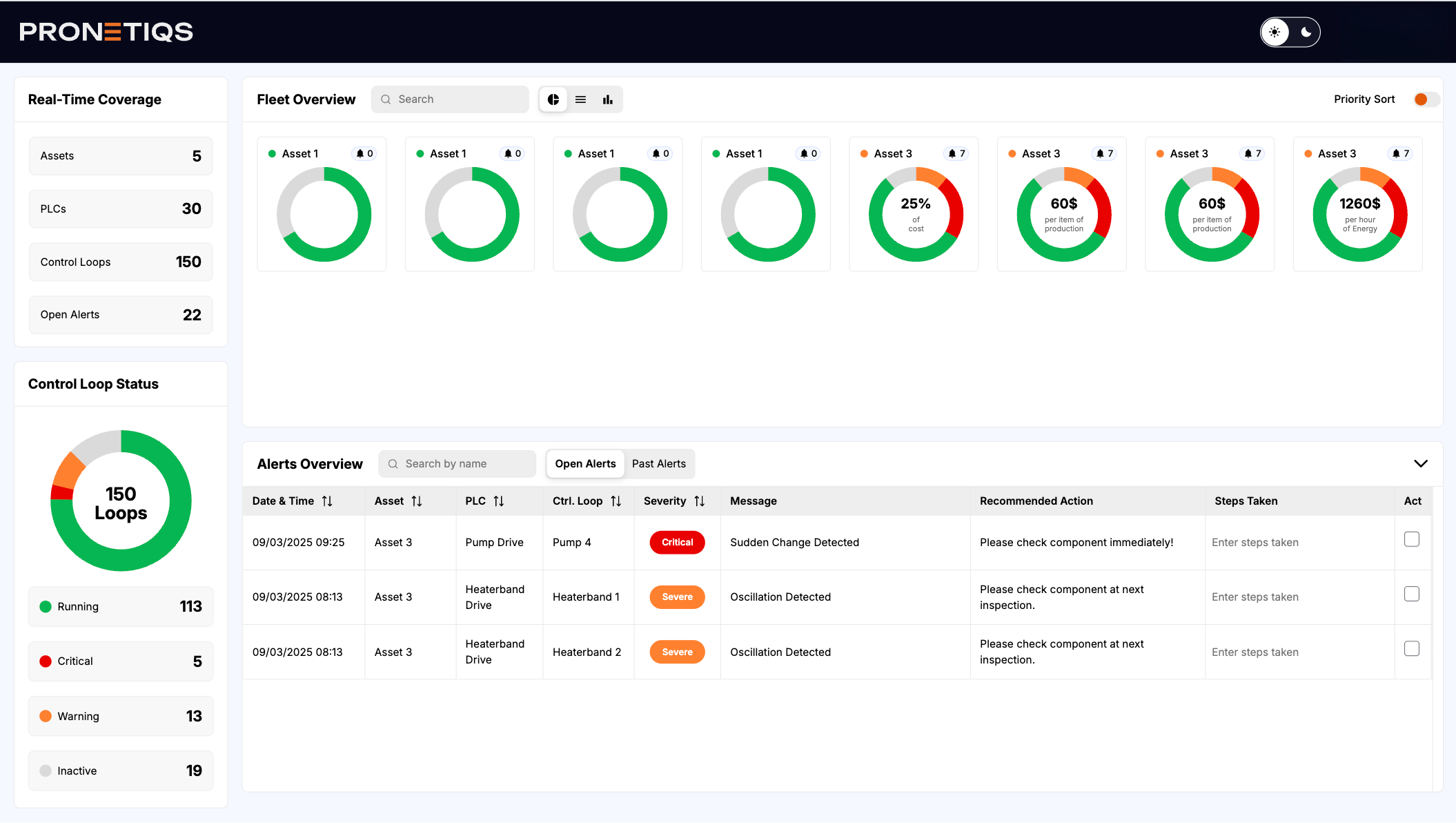
SID provides an overview of monitored assets, control-loop health and active alerts.
For maintenance and reliability teams, that can support:
- More targeted inspections.
- Better maintenance prioritization.
- Earlier investigation of developing problems.
- Planned intervention instead of emergency response.
- A clearer record of when equipment behaviour began to change.
Where this approach is most useful
Control-behaviour monitoring will not be the right fit for every asset.
The strongest applications generally involve:
- Automated equipment with accessible control-loop data.
- Repetitive or continuous operating patterns.
- Mechanical or thermal changes that affect how the controller responds.
- Machinery where failure, poor performance or quality loss carries a meaningful cost.
- Applications where the control system may compensate for deterioration before the problem becomes visible.
This can include controlled pumps, valves, motors, heating and cooling systems, hydraulic systems, robotic equipment and other automated machinery.
The important qualifying question is not simply whether the facility has PID loops. It is:
Could a change in equipment condition alter the control effort required to achieve the same result?
If the answer is yes, the control data may contain useful information about equipment health.
From “Is it running?” to “Is it behaving normally?”
A machine can be running and still be moving toward failure.
A process can be stable and still require increasing effort to remain stable.
That changes the maintenance question from:
“Is the machine still running?”
to:
“Is it taking more effort to keep it running?”
PRONETIQS SID is predictive-maintenance software designed to monitor changes in control-loop behaviour using data already available in industrial control systems. It operates on premises and can provide early indications of mechanical wear or faults without requiring additional condition-monitoring sensors or a cloud connection.
The objective is not to replace technicians, process knowledge or existing condition-monitoring programs. It is to make another source of early warning visible: the changing behaviour of the control system itself.
Because when the process still looks fine, the controller may already be telling you that something has changed.
Could this be happening in your process?
Have a loop that seems stable but an asset that keeps causing trouble?
Tell Streamline what the controller is managing and what behaviour you have noticed. We can help determine whether control-behaviour monitoring—and PRONETIQS SID—are worth exploring for the application.
Request an application review