
Streamline Process Management, Webinar
Before AI, Ask What Your Control Loops Already Know
A lower-complexity path to operational insight may already exist in your PLC data
AI has become a business question for industrial companies.
Leadership teams are asking where it can improve reliability, productivity and decision-making. Operations teams are being challenged to find practical use cases. And increasingly, companies are asking a second question:
What will all of that intelligence actually cost to run?
That is a healthy question.
The economics of AI extend beyond developing or training a model. Once AI becomes part of an operating workflow, there are ongoing costs associated with inference, infrastructure, integration, oversight and human attention.
For industrial teams, that creates an important decision point.
Before building another analytics layer around plant data, it may be worth asking:
What useful information are we already generating—and not using?
For anyone who works with PLCs and control loops, there is a good place to start.
Need a refresher on the underlying idea? See how control systems can compensate for developing equipment problems while the process still appears normal.
Before adding another layer of analytics, ask what the control system is already telling you.
Your control loop is already describing machine behaviour
The result may look normal while the effort changes
If you work with control systems, you already know the basic relationship.
A controller continuously works with:
- Setpoint: what the process needs to achieve.
- Process value: what is actually happening.
- Control output: the corrective action needed to close the gap.
Most of the time, we care about whether the controller succeeds.
Is the temperature holding?
Did the motor reach speed?
Is the valve maintaining flow?
Is pressure staying where it belongs?
But there is another question that may be just as valuable:
Has the amount or pattern of effort required to achieve that result changed?
A machine can continue meeting its setpoint even as its mechanical behaviour begins to change.
That is because the controller compensates.
A heater can require more output to reach the same temperature. A valve can respond more slowly but still reach position. A motor can take longer to reach speed while the controller continues correcting for it.
From the operating screen, the result may still look normal.
The relationship behind that result may not be.
A Hypothetical Example: Steel Rolling
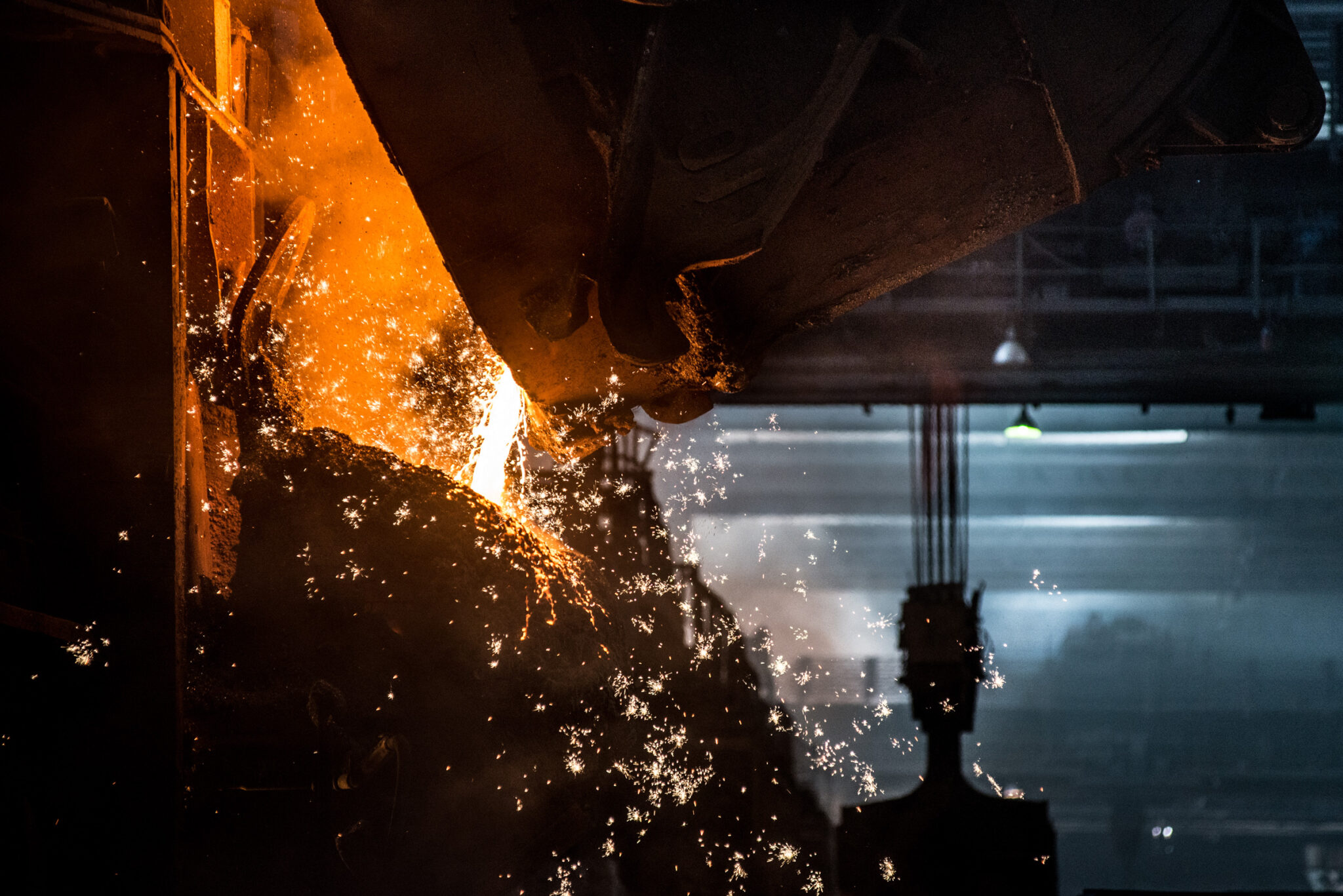
Consider a steel rolling application.
A rolling mill relies on tightly controlled speed, force, position and other process conditions. The control system is continuously correcting those variables to keep the line operating as required.
Now imagine that a drive, actuator or another mechanical component begins to deteriorate.
The process may not immediately move outside its limits. The controller can increase or alter its response to compensate for the change.
To the operator, the line may still appear stable.
But to someone examining how the relationship between setpoint, process value and control output changes over time, the equipment may already be behaving differently.
No generative-AI model is required to recognize the basic opportunity:
the control system is already producing information about how hard the machine is working to achieve the expected result.
The question is whether anyone is looking at that relationship.
Industrial AI can be extremely valuable.
There are applications where advanced models, large data sets, cloud infrastructure and enterprise-wide analytics are justified by the potential outcome.
But sophistication has a cost.
Before committing to a larger AI initiative, it is useful to ask:
What is the lowest-complexity way to get a useful answer?
Sometimes the answer may be a purpose-built diagnostic application using data that already exists in the control system.
Not every industrial problem needs a large AI project
Industrial AI can be extremely valuable.
There are applications where advanced models, large data sets, cloud infrastructure and enterprise-wide analytics are justified by the potential outcome.
But sophistication has a cost.
Before committing to a larger AI initiative, it is useful to ask:
What is the lowest-complexity way to get a useful answer?
Sometimes the answer may be a purpose-built diagnostic application using data that already exists in the control system.
That is different from:
- Moving every available tag into the cloud.
- Collecting more plant data before deciding what question needs to be answered.
- Developing a custom predictive model for every asset.
- Adding another dashboard and hoping someone notices the right pattern.
- Applying AI broadly before deciding which operational decision needs to improve.
The goal is not to use less technology for its own sake.
The goal is to match the complexity of the solution to the value of the problem being solved.
The goal is not to spend more on intelligence. The goal is to notice the right problem early enough to act.
Start with the operational question
A more useful way to frame an industrial intelligence project may be:
Which signal would change what you do?
For maintenance and reliability teams, that could mean recognizing that:
- A valve is beginning to respond differently.
- A motor requires increasing effort to maintain performance.
- A thermal process is behaving differently despite holding temperature.
- A controlled mechanical system is becoming less efficient.
- Equipment behaviour is changing before a traditional process alarm is triggered.
Those are specific operational questions.
And if the answer already exists in the relationship among setpoint, actual value and control output, a broad AI project may not be the first thing you need.
Where PRONETIQS SID fits
PRONETIQS SID takes a purpose-built approach to this problem.
Rather than requiring a custom predictive model for each individual machine, SID monitors how control loops behave over time and looks for changes in machine response.
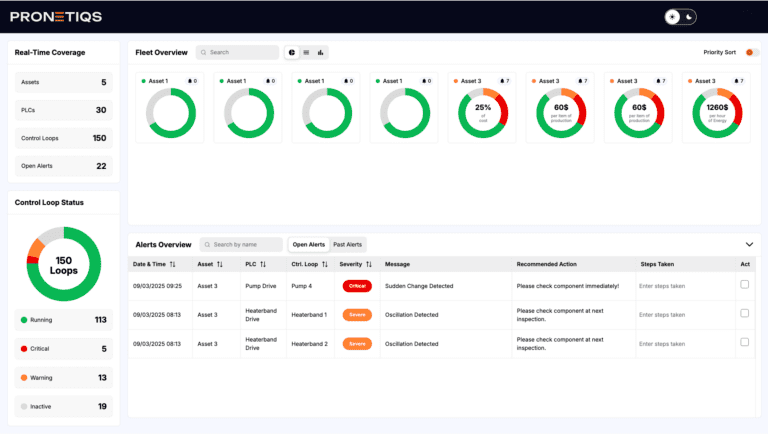
It uses existing control-system data to establish how an asset normally responds to control input and identifies deviations from that behaviour.
In practical terms, that means looking beyond:
“Did the loop reach setpoint?”
and asking:
“Is the machine responding to the controller the way it used to?”
SID is designed to provide an earlier reason to investigate developing mechanical deterioration without requiring additional condition-monitoring sensors or a months-long custom data-science project.
It is not a replacement for engineering judgment, maintenance expertise or every other form of condition monitoring.
It is another way to use information the automation system may already be generating.
This is not a fit for every plant
That distinction matters.
Control-behaviour diagnostics become much easier to evaluate when two things are already true.
1 – Someone understands control loops
The useful conversation begins with an understanding of what is being controlled, how the equipment should respond and which control variables are meaningful.
If no one involved understands the control application, identifying a useful monitoring strategy becomes considerably more difficult.
2 – Relevant control data is accessible
The plant also needs practical access to the data being generated by the PLC or automation system.
If the appropriate setpoint, actual value and control-output information cannot be accessed—or organizational restrictions make access unlikely—the immediate challenge is not predictive analytics.
It is data access.
For that reason, a strong SID candidate generally has:
- Automated equipment with meaningful control loops.
- Someone who understands the control application.
- Practical access to the relevant PLC or control-system data.
- Equipment where mechanical deterioration changes how the process responds.
- A business reason to detect that change earlier.
That last point is important.
Technology should follow the problem—not the other way around.
Before adding intelligence, use the intelligence you already have
The current AI conversation is forcing companies to think more carefully about where intelligence creates value.
That is a good development.
But industrial operations do not always need to begin by collecting more data, creating a larger infrastructure or applying a more sophisticated model.
Sometimes the better first question is much closer to the machine:
What is the control system already telling us?
If the process is still meeting its target but the controller is working differently to make that happen, there may already be a useful signal hiding in the data.
Before building another analytics layer, it may be worth looking there first.
Want to go deeper?
Join Streamline for our upcoming PRONETIQS SID webinar, and see how changes in control-loop behaviour can reveal developing equipment issues before they become obvious.
Sept 23, 2026 at 10am MT // 12pm ET
Do your control loops have more to tell you?
If your team understands the control application and has access to the relevant PLC data, Streamline can help determine whether control-behaviour monitoring with PRONETIQS SID is worth exploring.